Global Space Battery Market Research Report – Segmentation By Battery Type (Lithium-ion (Li-ion), Nickel-hydrogen (NiH2), Nickel-Cadmium (NiCd), Solid-state/Lithium-metal, Silver-zinc and Other); By Platform (Satellites, Crewed Spacecraft and Space Stations, Launch Vehicles and Planetary Landers and Rovers); By Orbit Class (Low Earth Orbit (LEO), Medium Earth Orbit (MEO), Deep-Space / Interplanetary and Geostationary Orbit (GEO)); By Energy-Density Band (Less than 100 Wh/kg, 100–200 Wh/kg and More than 200 Wh/kg); By Function (Primary (Non-Rechargeable) and Secondary (Rechargeable)); Region – Forecast (2025 – 2030)
Space Battery Market Size and Overview:
The Space Battery Market was valued at USD 3.38 Billion in 2024 and is projected to reach a market size of USD 5.88 Billion by the end of 2030. Over the forecast period of 2025-2030, the market is projected to grow at a CAGR of 9.68%.
Key Market Insights:
The space sector is rapidly advancing toward new horizons, with frequent announcements highlighting significant progress across the globe. Whether it involves the trial of an advanced rocket technology, the deployment of a cutting-edge satellite, or the successful lunar landing of an autonomous exploration vehicle, momentum in space-related activities continues to build.
Key factors propelling the expansion of the space economy include the growing need for satellite-based connectivity, rising usage of positioning and navigation functionalities on mobile devices, and the increasing reliance on insights generated through artificial intelligence and machine learning.
Market Drivers:
The swift expansion of small-satellite constellations is a key factor contributing to the market’s continued growth.
Increased launch frequencies are shortening procurement timelines, prompting buyers to favor suppliers equipped with automated build-to-print manufacturing capabilities and proven flight heritage. Bulk orders enhance economies of scale, enabling system integrators to focus on optimizing cost-per-watt instead of overall unit price. Cold-temperature charge acceptance continues to be a critical performance factor, given the frequent eclipse transitions encountered by LEO platforms. Adherence to ECSS-E-ST-20-20C standards remains mandatory, requiring vendors to uphold comprehensive and well-documented data packages.
The transition from nickel-hydrogen to high-energy-density lithium-ion chemistries is a significant driver of market expansion.
The shift from traditional nickel-hydrogen batteries to lithium-ion technology reduces battery mass by as much as 40%, creating additional volume for payloads or propellant. GEO telecommunications providers are able to increase revenue by deploying heavier transponders within current fairing constraints, while government space initiatives benefit from accelerated mission timelines enabled by lighter transfer stages. Lithium-ion systems also maintain stable capacity across a broad temperature range of −20 °C to +50 °C, decreasing reliance on thermal heaters and streamlining thermal management. Long-duration flight data demonstrates less than 2% capacity degradation after 13 years in GEO orbit, strengthening operator trust. Consequently, legacy nickel-hydrogen production lines are being phased out, and component manufacturers are redirecting efforts toward next-generation anode materials.
Market Restraints and Challenges:
The substantial costs associated with development and deployment continue to pose challenges to market growth.
One of the key constraints in the market is the elevated cost linked to the development and deployment of space-grade batteries. Meeting the rigorous demands for performance, longevity, and reliability in extreme space environments requires extensive validation processes and the integration of highly specialized materials, significantly increasing overall expenses. For instance, the cost of engineering lithium-ion batteries for space use can be up to five times higher than for terrestrial applications. Furthermore, technical setbacks leading to mission delays often contribute to budget escalations. A 2024 Deloitte report underscores that cost overruns remain a persistent issue in space technology initiatives, reinforcing the importance of pursuing cost-efficient innovation strategies.
Market Opportunities:
The integration of space-grade battery systems with renewable energy technologies presents new opportunities for market expansion.
The integration of space-grade batteries with renewable energy systems—particularly solar panels—represents a notable opportunity for market growth. Solar-powered energy storage solutions enable sustained power supply during extended space missions, proving especially valuable for interplanetary exploration and the operation of lunar installations. According to a 2025 report by the International Renewable Energy Agency (IRENA), incorporating renewable energy into space missions can reduce dependence on non-renewable power sources, supporting broader sustainability objectives.
Recent developments reflect this emerging trend. In November 2024, Maxar Technologies announced the successful deployment of solar-powered battery systems on its next-generation geostationary satellites, enhancing mission duration while lowering long-term maintenance requirements. Similarly, in December 2024, Airbus Defence and Space unveiled a solar-battery hybrid power system for its satellite platforms, illustrating the growing potential of renewable energy integration in the space industry.
SPACE BATTERY MARKET REPORT COVERAGE:
REPORT METRIC
DETAILS
Market Size Available
2024 - 2030
Base Year
2024
Forecast Period
2025 - 2030
CAGR
9.68%
Segments Covered
By Battery Type, Platform, Orbit Class, Energy-Density Band, Function and Region
Various Analyses Covered
Global, Regional & Country Level Analysis, Segment-Level Analysis, DROC, PESTLE Analysis, Porter’s Five Forces Analysis, Competitive Landscape, Analyst Overview on Investment Opportunities
Regional Scope
North America, Europe, APAC, Latin America, Middle East & Africa
Key Companies Profiled
Saft Groupe S.A., GS Yuasa International Ltd., EaglePicher Technologies, EnerSys, VARTA AG, BYD Company Ltd., Tadiran Batteries, Maxell Holdings, Ltd., Panasonic Corporation, Exide Technologies
Space Battery Market Segmentation:
Space Battery Market Segmentation By Battery Type:
Lithium-ion (Li-ion)
Nickel-hydrogen (NiH2)
Nickel-Cadmium (NiCd)
Solid-state/Lithium-metal
Silver-zinc
Other
Lithium-ion batteries currently dominate the space battery market, supported by decades of operational data and advancements in manufacturing yields. With nearly 620 million cumulative cell-hours of flight heritage, procurement confidence remains strong. High-nickel NCA and NCM chemistries now achieve energy densities of up to 214 Wh/kg at the pack level. This segment also benefits from well-established supply chains, ranging from electrode foil production to custom-engineered pressure vessels.
Meanwhile, the market share attributed to solid-state and lithium-metal chemistries is projected to grow at a CAGR of 15.60%, driven by mission requirements that prioritize specific energy levels near 400 Wh/kg and enhanced resistance to thermal runaway. Nickel-cadmium (NiCd) and nickel-hydrogen (NiH₂) technologies continue to serve niche applications—particularly in environments where extreme cold storage (down to −60 °C) or indefinite trickle-charge capability is more critical than mass efficiency. Silver-zinc batteries remain relevant for launch vehicles that demand high burst power during ignition and stage separation events.
The transition toward solid-state batteries depends heavily on overcoming technical barriers, such as scaling sintered ceramic electrolytes to satellite-grade formats without structural failure and achieving cycle life beyond 1,000 charge-discharge cycles. Leading manufacturers are addressing these challenges by integrating solid-state cell stacks with flex-rigid battery management systems to mitigate micro-vibration-induced delamination. Government funding is helping offset initial manufacturing inefficiencies, though a full-scale market transition is expected to span the entire forecast period. During this time, hybrid battery packs—featuring Li-ion cells for baseline loads and next-generation chemistries for peak power demands—are expected to become increasingly common.
Space Battery Market By Platform:
Satellites
Crewed Spacecraft and Space Stations
Launch Vehicles
Planetary Landers and Rovers
Satellites hold the largest share of the space batteries market, underscoring their role as the primary volume driver within the sector. Standardized battery specifications and large-scale manufacturing enable constellation operators to achieve competitive cost-per-watt-hour metrics—particularly for major fleets like SpaceX, OneWeb, and Amazon’s Project Kuiper, which anticipate thousands of launches. Typical satellite platforms incorporate battery systems ranging from 50 to 200 Wh to manage rapid eclipse cycles while adhering to stringent mass constraints, giving qualified lithium-ion chemistries a clear advantage in procurement processes. High-volume demand further allows suppliers to amortize the significant non-recurring engineering expenses associated with ECSS qualification, thereby reducing unit costs for subsequent orders.
Launch vehicles represent a smaller yet technically intensive segment, requiring burst-power battery packs to support ignition and stage separation events. Conversely, crewed spacecraft and space stations mandate human-rated batteries equipped with redundant safety circuits and pressure-relief mechanisms to satisfy rigorous flight-worthiness standards.
Planetary landers and rovers constitute the fastest-growing platform segment, projected to expand at a CAGR of 13.40% through 2030 as Artemis-related lunar missions and Mars reconnaissance projects transition from design phases to operational hardware. These missions demand multi-kilowatt-hour battery arrays capable of long dormancy periods followed by reliable activation under extreme environmental conditions—ranging from lunar night temperatures of −150 °C to dust-laden noon highs exceeding 100 °C. Qualification protocols include prolonged thermal-vacuum exposure, vibration tests simulating launch and landing shocks, and radiation resistance assessments surpassing deep-space cruise levels to ensure mission success where in-situ repairs are not feasible. Mitsubishi Electric’s contract to supply lithium-ion batteries for NASA’s Gateway lunar platform highlights how premium, radiation-hardened battery solutions are reshaping supplier offerings. As planetary exploration expands, vendors with proven heritage in lander and rover applications are positioned to command premium pricing, even as the broader space batteries market continues to scale primarily on satellite demand.
Space Battery Market By Orbit Class:
Low Earth Orbit (LEO)
Medium Earth Orbit (MEO)
Deep-Space / Interplanetary
Geostationary Orbit (GEO)
The space batteries market holds its largest share within Low Earth Orbit (LEO) deployments, driven primarily by broadband and Earth observation constellations that prioritize cost per watt-hour above all else. These fleets operate with state-of-charge windows as low as 20% during frequent eclipse periods and multiple daily ground station passes. While less numerous, deep-space missions necessitate significant design innovations: battery cells must withstand intense galactic cosmic radiation and endure wide temperature fluctuations without the benefit of convective cooling.
Medium Earth Orbit (MEO) navigation satellites require batteries with enhanced radiation shielding and minimal self-discharge to maintain precise clock stability. Geostationary Earth Orbit (GEO) communications satellites face extended eclipse durations of up to 72 minutes, prompting the use of lithium-ion battery strings equipped with thicker current collectors and binders rated for elevated temperatures. Additionally, as spacecraft transition from chemical to electric propulsion systems, peak battery power requirements increase, driving the adoption of higher voltage architectures.
Space Battery Market By Energy-Density Band:
Less than 100 Wh/kg
100–200 Wh/kg
More than 200 Wh/kg
Batteries with energy densities between 100 Wh/kg and 200 Wh/kg currently hold the largest market share, offering an optimal balance between reliability and cost-efficiency. These designs typically utilize well-established 18650 and 21700 cell formats, repackaged within welded aluminum enclosures featuring dual-redundant pressure-relief valves. The segment exceeding 200 Wh/kg, which is projected to experience significant growth, appeals primarily due to its mass savings—enabling either increased payload capacity or additional propellant. Development efforts focus on silicon-enriched anodes and high-nickel cathodes, stabilized by advanced separators that minimize or eliminate PFAS compounds where feasible.
Battery packs with energy densities below 100 Wh/kg are primarily deployed in sounding rockets and re-entry capsules, where extreme thermal shocks are a critical consideration. Despite this, the broader market is expected to surpass the 300 Wh/kg benchmark in pilot flights by 2028, driven by advancements in sintered solid electrolytes and lithium–sulfur technologies.
Space Battery Market By Function:
Primary (Non-Rechargeable)
Secondary (Rechargeable)
Secondary rechargeable battery systems are driving the highest revenue growth, as the majority of spacecraft must endure thousands of eclipse cycles. Their slow calendar aging and sophisticated state-of-health monitoring algorithms support a projected CAGR of 10.54% through 2030. Industry research and development efforts are heavily focused on silicon-based anodes, which mitigate electrode swelling and extend calendar life beyond 15 years.
Primary batteries continue to play a critical role in launch vehicles and planetary probes, providing reliable power for one-time high-energy bursts. Silver-zinc modules offer gravimetric power densities exceeding 400 W/kg but are limited by their short cycle life, restricting their use to expendable stages. Mission planners increasingly adopt hybrid battery configurations, combining primary cells for descent maneuvers with rechargeable systems for sustained surface operations.
Space Battery Market Segmentation: Regional Analysis:
North America
Europe
Asia-Pacific
South America
Middle East & Africa
North America leads the space batteries market, driven by NASA’s steady procurement pipeline and major prime contractors that collectively award multi-year battery contracts. Saft’s expansion of its Jacksonville facility to a 5 GWh annual production capacity highlights the region’s dedication to securing a domestic cell supply. Additionally, the Inflation Reduction Act provides investment credits that help offset costs associated with US-sourced cobalt and nickel intermediates. Canada contributes specialty thermal insulation blankets and pressure vessels, while Mexico manufactures non-flight ground-support equipment.
The Asia-Pacific region exhibits the fastest market growth. India is advancing toward its goal of a USD 44 billion space economy by 2033, leveraging public-private partnerships to establish cell assembly lines alongside launcher integration facilities. Japanese satellite manufacturers prioritize domestically produced batteries, as demonstrated by contracts to supply lithium-ion packs for the Gateway platform. China’s vertically integrated industry predominantly supports national space programs, although technology transfer restrictions limit Western involvement. South Korea is innovating in pouch-cell coating processes adapted from its electric vehicle industry, and Australia is investing in laboratory-scale lithium-sulfur research targeting lunar rover applications.
Space Battery Market COVID-19 Impact Analysis:
The global space battery market faced considerable challenges as a result of the COVID-19 pandemic. Disruptions across international supply chains significantly impacted the manufacturing and distribution of space batteries. Producers experienced obstacles in procuring essential raw materials and components, causing delays in production schedules. Moreover, the pandemic led to a decline in demand for specific categories of space batteries, particularly within the commercial space segment.
Latest Trends and Developments:
Maxar Technologies has successfully implemented advanced solar-powered battery systems in its latest geostationary satellites, enhancing both energy efficiency and mission duration. This development highlights the company’s dedication to incorporating renewable energy solutions within space technology.
Similarly, Airbus Defence and Space introduced a solar-battery hybrid system for its satellite platforms, demonstrating the growing importance of renewable energy integration in improving operational performance and sustainability in space missions.
Key Players in the Market:
Saft Groupe S.A.
GS Yuasa International Ltd.
EaglePicher Technologies
EnerSys
VARTA AG
BYD Company Ltd.
Tadiran Batteries
Maxell Holdings, Ltd.
Panasonic Corporation
Exide Technologies
Market News:
September 2025: KULR Technology Group, Inc. introduced six new commercial off-the-shelf (COTS) variants of its KULR ONE Space (K1S) CubeSat battery series, offering capacities ranging from 100 to 500 Wh. These batteries are engineered to address the increasing requirements of clients within the space industry, reflecting the company’s commitment to innovation in advanced technologies.
December 2024: KULR Technology Group, Inc. announced its intention to deploy the KULR ONE Space (K1S) battery on a SpaceX rideshare mission scheduled for 2026, facilitated by Exolaunch. This planned launch reinforces KULR’s strategic focus on delivering cutting-edge battery solutions tailored to the expanding space battery market.
To Learn more about this report,
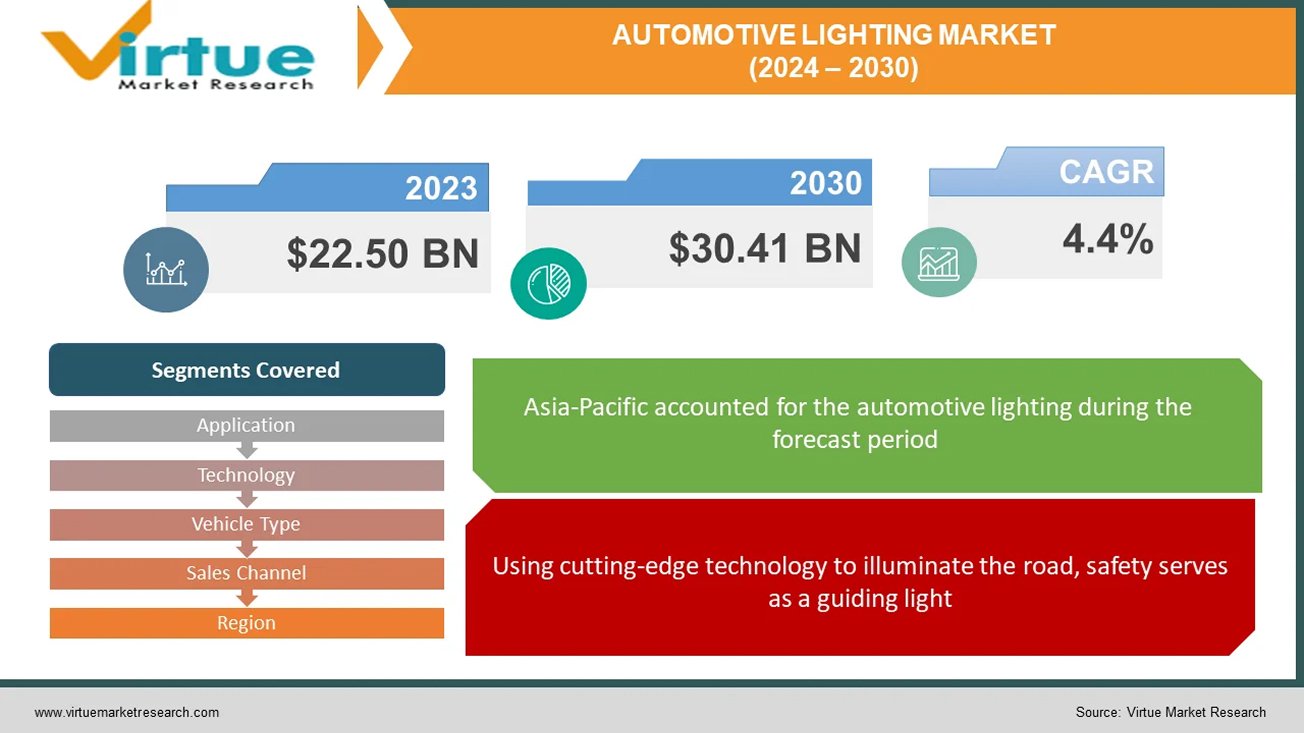
Global automotive lighting refers to all vehicle lighting systems, from headlamps that illuminate the road to taillights that communicate movements. They guarantee motorists and other road users alike safety, visibility, and style. While taillights frequently use LEDs for improved visibility, headlights are available in a variety of technologies, including LED and laser. Interior illumination, DRLs, and signal lights all have a role to play. This market, which was estimated to be worth $33.64 billion in 2022, is anticipated to rise to $67.39 billion by 2030 because of laws, luxury tastes, safety concerns, and technological developments like OLED taillights and adaptive headlights. Anticipate a future dominated by intelligent, connected, personalized, and sustainable lighting systems that enhance the safety, efficiency, and aesthetic appeal of automobiles.
Key Market Insights:
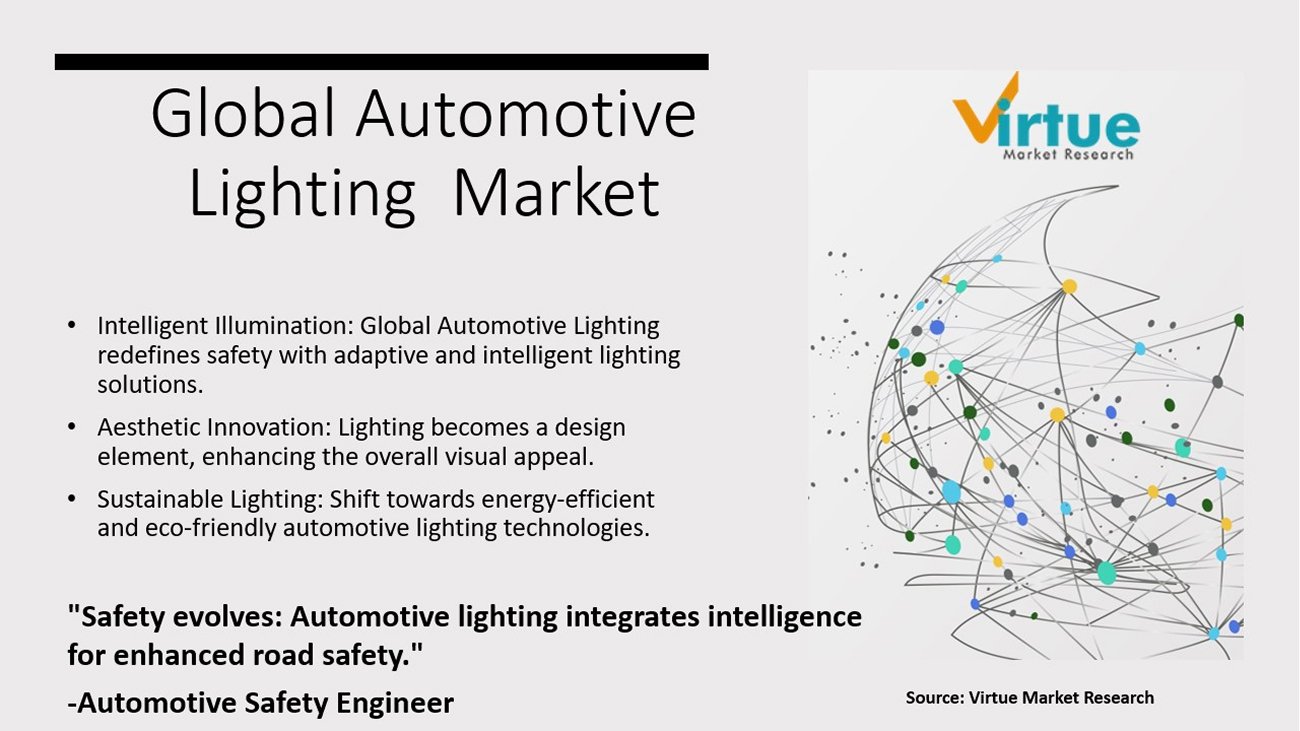
Car lighting works its magic to provide safety, visibility, and style. Headlights cut through the night, taillights express intent, and interiors shine with comfort. The billion-dollar global business is expected to rise due to consumer demand for high-end experiences, safer roads, and cutting-edge technology. Imagine dynamic messages being painted by taillights, headlights that adjust to the road, and interiors that customize their atmosphere. Driven by technological advancements like linked systems and laser beams, this future is calling. Anticipate even more visually attractive, environmentally friendly, and intelligent lighting to illuminate the way ahead, making cars safer, more efficient, and unquestionably cooler.
Global Automotive Lighting Market Drivers:
Using cutting-edge technology to illuminate the road, safety serves as a guiding light.
In the market for automobile lighting, safety is the driving force behind demand from the public and laws. While automated high beams smoothly react to traffic, adaptive headlights modify their beams so as not to blind other people. With visually striking displays, dynamic taillights convey intentions for braking and turning. Beyond these developments, integrated pedestrian identification and lane departure alerts will soon make roads safer and brighter for everyone.
Beyond Performance-Based Luxuries Redefined by Light.
Luxurious automobile lighting creates a distinct visual identity that goes beyond simple illumination. Personalized interior lighting customizes the driving experience by setting the mood with a range of colours and intensities, while intricate designs and distinctive DRLs modify exteriors. As you approach your automobile at night, welcoming lights lead the way, resulting in an interior that is perfectly lit. Not only is this symphony of light aesthetically pleasing, but it also stands as a tribute to luxury. Upcoming developments like gesture-controlled lighting and holographic displays promise to further enhance the experience.
Fuel Efficiency Takes the Lead: Illuminating Sustainability
The worldwide automotive lighting market is undergoing a significant transition towards energy-efficient solutions, as environmental concerns gain prominence. LED technology is leading the way, providing a ray of hope for the environment and drivers alike. LED lights beam brighter and use a lot less energy than conventional halogen lamps. There are some tangible advantages to this. For drivers, this translates to increased fuel economy, which lowers petrol prices and lessens reliance on fossil fuels. Greater air quality and a reduction in the transport sector's contribution to climate change are the results of reduced overall emissions.
To Learn more about this report,
Global Automotive Lighting Market Restraints and Challenges:
Although the global automotive lighting business is booming, there are still unknowns. Difficulties impede growth even as innovation propels it with eye catching features like laser beams and adaptable headlights. These technologies are luxury items due to their high cost and difficult integration, which puts producers' abilities to the test. The worldwide patchwork created by unclear legislation limits the potential of innovation. Durability issues persist, particularly when complex systems are subjected to challenging conditions. Ultimately, a lot of drivers still don't fully understand how these improvements can help them. Together, we can overcome these obstacles. The keys to reducing costs are improved production, more seamless integration, and unified regulations. Their full potential can be realized by educating customers about the safety, efficiency, and aesthetic value of these lighting wonders. By working together, we can pave the way for an even brighter and safer future for vehicle lighting.
Global Automotive Lighting Market Opportunities:
It is made possible by advanced LED technology, which gives drivers the ability to customize their illumination for the highest level of comfort and flair. Consumers that care about the environment want greener products, and vehicle lighting complies. While solar- and self-powered lighting technologies offer a future powered by clean energy, energy-efficient LEDs lower pollution. The advent of connected lighting systems heralds a new age. Envision automobiles interacting with infrastructure and one another to minimize accidents and enhance traffic efficiency. Integrated headlights with pedestrian recognition provide unmatched safety, while dramatic taillights with eye-catching displays alert onlookers to your intentions. The possibilities are endless in the future. Gesture-controlled interior illumination, holographic displays projected onto the road, and even light fixtures with self-healing capabilities.
AUTOMOTIVE LIGHTING MARKET REPORT COVERAGE:
To Learn more about this report,
Global Automotive Lighting Market Segmentation: By Application
Exterior Lighting
Interior Lighting
Due to laws requiring safety features like headlights, taillights, and brake lights, exterior lighting presently holds the most market share in the vehicle lighting industry. The dominance of this market is partly attributed to advancements in safety-focused technologies such as adaptive headlights and daytime running lights. The market value of external lighting is increased by the quick adoption of technology like LED bulbs and laser lights, which improve performance and aesthetics. Conversely, the interior lighting market is expected to increase at the fastest rate in the upcoming years. Innovations like ambient lighting and technology breakthroughs like LED and OLED displays, driven by consumer demand for comfort and personalisation, open new possibilities. The spread of sophisticated interior lighting systems is further driven by the growing emphasis on safety and the expansion of the luxury car market.
Global Automotive Lighting Market Segmentation: By Technology
Halogen
LED (Light-Emitting Diode)
Xenon
Emerging Technologies
The worldwide vehicle lighting market is currently dominated by halogen because of its more affordable price, advanced technology, and useful illumination. With its dependable supply chain and affordable option for manufacturers and cost-conscious customers, halogen holds the biggest market share. The fastest-growing market right now is LEDs, which are predicted to shortly overtake halogen. The rapid expansion of LEDs is driven by their higher efficiency, longer lifespan, flexibility in design, and technological breakthroughs including enhanced brightness. Because LEDs use less energy and produce fewer emissions and better fuel economy, they are becoming more and more popular in the changing automotive lighting market.
Global Automotive Lighting Market Segmentation: By Vehicle Type
Passenger Cars
Commercial Vehicles
Passenger automobiles rule the worldwide automotive lighting market. The sheer number of passenger cars produced which surpasses that of business vehicles and fuels the need for lighting systems is the primary cause of this popularity. The growing demand for personal automobiles in developing nations is a result of rising disposable income, which in turn drives the rise of the passenger car market. The importance that consumers place on safety and aesthetics elements helps to drive market expansion. But in the upcoming years, the market for electric and hybrid cars is expected to develop at the quickest rate. The exponential rise of the worldwide electric car market, which is still expanding and shows no signs of slowing down, is what is driving this surge. Specialised lighting solutions are required since electric and hybrid vehicles have different lighting requirements because of their specific functionality and design aesthetics.
Global Automotive Lighting Market Segmentation: By Sales Channel
OEM (Original Equipment Manufacturers)
Aftermarket
Most lighting systems sold nowadays are sold by OEMs (Original Equipment Manufacturers), primarily because manufacturers pre-install lighting systems in new cars. But in the next years, the aftermarket is expected to develop at the quickest rate. This spike in demand for replacement parts, especially lighting systems, can be linked to several variables, one of them being the average age of cars. The industry is expanding because of consumers' growing desire to personalise their cars with aftermarket lighting upgrades such LED upgrades and decorative lighting. The availability and affordability of technologies like adaptive headlights and laser lights in the aftermarket, together with other advancements in lighting technology, are driving demand even more. Moreover, the growing market for electric cars (EVs).
To Learn more about this report,
Global Automotive Lighting Market Segmentation: By Region
North America
Asia-Pacific
Europe
South America
Middle East and Africa
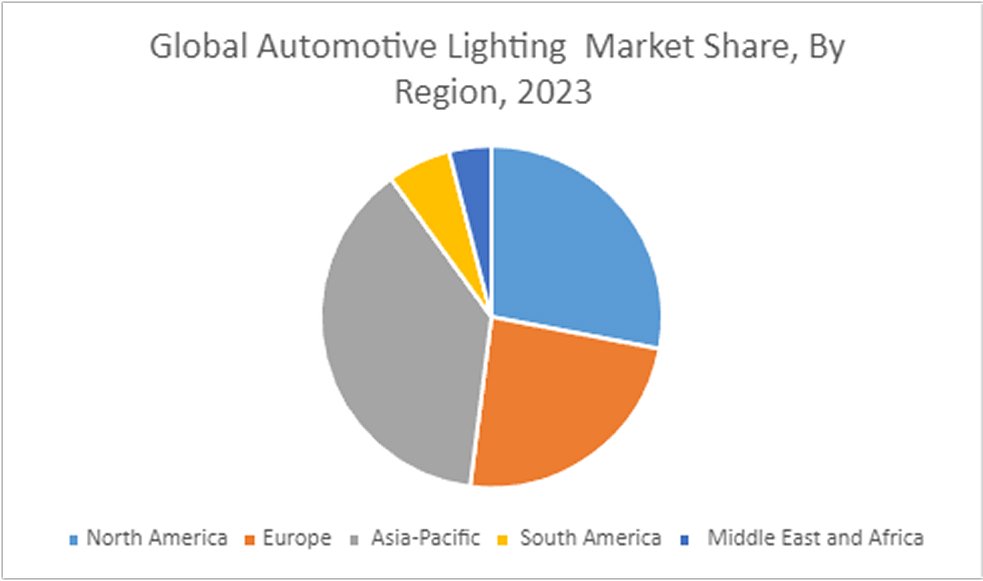
Throughout the forecast period, Asia Pacific is anticipated to be the automotive lighting market with the highest profitability. Over the past few years, Asia Pacific countries like China and India have seen notable increases in automotive manufacturing and sales, primarily in the medium-to premium luxury car segment. Asia Pacific is predicted to see an increase in the manufacturing of passenger cars, with India experiencing the strongest growth rate. Depending on the state of the national economy, the area offers a suitable selection of both high-end and cheap cars. For instance, there is a substantial demand for halogen, Xenon/HID, and LED since China and India produce more economy and mid-range automobiles. On the other hand, luxury car adoption rates are greater in South Korea and Japan, where LED lighting is the norm.
COVID-19 Impact Analysis on the Global Automotive Lighting Market:
A brief shadow was thrown by COVID-19 over the worldwide automotive lighting market. Production was stopped by lockdowns and supply chain disruptions, while luxury lighting upgrades were shelved by consumers on a tight budget. Resources became scarce, and R&D stagnated. Still, the market is recovering thanks to resurgent demand and rearranged priorities. While energy-efficient LEDs are being pushed towards adoption by sustainability, safety concerns are driving interest in features like pedestrian detection and adaptive headlights. The digital push of the epidemic creates opportunities for intelligent, networked lighting systems that may interact with infrastructure and other cars. Ultimately, the industry is positioned to shine brighter, focused on safety, sustainability, and a connected future, even though the pandemic dimmed its brilliance.
Recent Trends and Developments in the Global Automotive Lighting Market:
A development collaboration between OSRAM Continental and REHAU aims to incorporate lighting into external components, providing automobile manufacturers with innovative lighting options that improve functionality and design flexibility. For rear combination lamps, Hella unveiled a revolutionary lighting innovation called Hella FlatLight technology. A Memorandum of Understanding (MoU) was signed by Samvardhana Motherson Automotive Systems Group BV (SMRPBV), a division of Motherson Group, and Marelli Automotive Lighting to investigate a technology collaboration focused on intelligently lighted external body components. Valeo debuted their revolutionary 360° lighting system at the Shanghai Auto Show. This technology surrounds the car with a band of light, projecting instantaneous, clear signs that other drivers can see from a distance. Pedestrians, cyclists, and scooter riders are especially susceptible to these signals
Key Players:
AMS Osram
Cree
Hella
Hyundai Mobis
Koito
Luminus Devices
Magneti Marelli
Osram Licht AG
Stanley Electric
Valeo
Chapter 1. SPACE BATTERY MARKET – SCOPE & METHODOLOGY
1.1. Market Segmentation
1.2. Scope, Assumptions & Limitations
1.3. Research Methodology
1.4. Primary End-user Application .
1.5. Secondary End-user Application Chapter 2. SPACE BATTERY MARKET – EXECUTIVE SUMMARY
2.1. Market Size & Forecast – (2025 – 2030) ($M/$Bn)
2.2. Key Trends & Insights
2.2.1. Demand Side
2.2.2. Supply Side
2.3. Attractive Investment Propositions
2.4. COVID-19 Impact Analysis Chapter 3. SPACE BATTERY MARKET – COMPETITION SCENARIO
3.1. Market Share Analysis & Company Benchmarking
3.2. Competitive Strategy & Development Scenario
3.3. Competitive Pricing Analysis
3.4. Supplier-Distributor Analysis Chapter 4. SPACE BATTERY MARKET - ENTRY SCENARIO
4.1. Regulatory Scenario
4.2. Case Studies – Key Start-ups
4.3. Customer Analysis
4.4. PESTLE Analysis
4.5. Porters Five Force Model
4.5.1. Bargaining Frontline Workers Training of Suppliers
4.5.2. Bargaining Risk Analytics s of Customers
4.5.3. Threat of New Entrants
4.5.4. Rivalry among Existing Players
4.5.5. Threat of Substitutes Players
4.5.6. Threat of Substitutes Chapter 5. SPACE BATTERY MARKET - LANDSCAPE
5.1. Value Chain Analysis – Key Stakeholders Impact Analysis
5.2. Market Drivers
5.3. Market Restraints/Challenges
5.4. Market Opportunities Chapter 6. SPACE BATTERY MARKET – By Battery Type
6.1 Introduction/Key Findings
6.2 Lithium-ion (Li-ion)
6.3 Nickel-hydrogen (NiH2)
6.4 Nickel-Cadmium (NiCd)
6.5 Solid-state/Lithium-metal
6.6 Silver-zinc
6.7 Other
6.8 Y-O-Y Growth trend Analysis By Battery Type
6.9 Absolute $ Opportunity Analysis By Battery Type , 2025-2030 Chapter 7. SPACE BATTERY MARKET – By Platform
7.1 Introduction/Key Findings
7.2 Satellites
7.3 Crewed Spacecraft and Space Stations
7.4 Launch Vehicles
7.5 Planetary Landers and Rovers
7.6 Y-O-Y Growth trend Analysis By Platform
7.7 Absolute $ Opportunity Analysis By Platform, 2025-2030 Chapter 8. SPACE BATTERY MARKET – By Organization Size
8.1 Introduction/Key Findings
8.2 Large Enterprises
8.3 Small and Medium-sized Enterprises (SMEs)
8.4 Y-O-Y Growth trend Analysis By Organization Size
8.5 Absolute $ Opportunity Analysis By Organization Size 2025-2030 Chapter 9. SPACE BATTERY MARKET – By Orbit Class
9.1 Introduction/Key Findings
9.2 Low Earth Orbit (LEO)
9.3 Medium Earth Orbit (MEO)
9.4 Deep-Space / Interplanetary
9.5 Geostationary Orbit (GEO)
9.6 Y-O-Y Growth trend Analysis By Orbit Class
9.7 Absolute $ Opportunity Analysis By Orbit Class, 2025-2030
Chapter 10. SPACE BATTERY MARKET – By Function
10.1 Introduction/Key Findings
10.2 Primary (Non-Rechargeable)
10.3 Secondary (Rechargeable)
10.4 Y-O-Y Growth trend Analysis By Function
10.5 Absolute $ Opportunity Analysis By Function, 2025-2030
Chapter 11. SPACE BATTERY MARKET – By Geography – Market Size, Forecast, Trends & Insights
11.1. North America
11.1.1. By Country
11.1.1.1. U.S.A.
11.1.1.2. Canada
11.1.1.3. Mexico
11.1.2. By Battery Type
11.1.3. By Platform
11.1.4. By Orbit Class
11.1.5. By Energy-Density Band
11.1.6. By Function
11.1.7. Countries & Segments - Market Attractiveness Analysis
11.2. Europe
11.2.1. By Country
11.2.1.1. U.K.
11.2.1.2. Germany
11.2.1.3. France
11.2.1.4. Italy
11.2.1.5. Spain
11.2.1.6. Rest of Europe
11.2.2. By Battery Type
11.2.3. By Platform
11.2.4. By Orbit Class
11.2.5. By Energy-Density Band
11.2.6. By Function
11.2.7. Countries & Segments - Market Attractiveness Analysis
11.3. Asia Pacific
11.3.1. By Country
11.3.1.1. China
11.3.1.2. Japan
11.3.1.3. South Korea
11.3.1.4. India
11.3.1.5. Australia & New Zealand
11.3.1.6. Rest of Asia-Pacific
11.3.2. By Battery Type
11.3.3. By Platform
11.3.4. By Orbit Class
11.3.5. By Energy-Density Band
11.3.6. By Function
11.3.7. Countries & Segments - Market Attractiveness Analysis
11.4. South America
11.4.1. By Country
11.4.1.1. Brazil
11.4.1.2. Argentina
11.4.1.3. Colombia
11.4.1.4. Chile
11.4.1.5. Rest of South America
11.4.2. By Battery Type
11.4.3. By Platform
11.4.4. By Orbit Class
11.4.5. By Energy-Density Band
11.4.6. By Function
11.4.7. Countries & Segments - Market Attractiveness Analysis
11.5. Middle East & Africa
11.5.1. By Country
11.5.1.1. United Arab Emirates (UAE)
11.5.1.2. Saudi Arabia
11.5.1.3. Qatar
11.5.1.4. Israel
11.5.1.5. South Africa
11.5.1.6. Nigeria
11.5.1.7. Kenya
11.5.1.8. Egypt
11.5.1.9. Rest of MEA
11.5.2. By Battery Type
11.5.3. By Platform
11.5.4. By Orbit Class
11.5.5. By Energy-Density Band
11.5.6. By Function
11.5.7. Countries & Segments - Market Attractiveness Analysis
Chapter 12. SPACE BATTERY MARKET – Company Profiles – (Overview, Type of Training Portfolio, Financials, Strategies & Developments)
12.1 Saft Groupe S.A.
12.2 GS Yuasa International Ltd.
12.3 EaglePicher Technologies
12.4 EnerSys
12.5 VARTA AG
12.6 BYD Company Ltd.
12.7 Tadiran Batteries
12.8 Maxell Holdings, Ltd.
12.9 Panasonic Corporation
12.10 Exide Technologies
Report Code: VMR-18936 | Published Date: December 2025 | Format: Excel and PDF
In 2025, the global Distribution Grid Automation Market was valued at approximately USD 18.4 billion. The market is projected to expand at a compound annual growth rate of around 11.7% during 2026–2030, reaching USD 32.1...
Report Code: VMR-9988 | Published Date: October 2024 | Format: Excel and PDF
The Global Energy Storage Systems Market was valued at USD 45.3 billion in 2023 and is projected to grow at a CAGR of 10.3% from 2024 to 2030, reaching approximately USD 90 billion by 2030.
Report Code: VMR-6921 | Published Date: October 2024 | Format: Excel and PDF
The Thermal Energy Storage Market was valued at USD 6.8 Billion in 2024 and is projected to reach a market size of USD 14.11 Billion by the end of 2030. Over the forecast period of 2025-2030, the market is projected to g...
Report Code: VMR-19022 | Published Date: January 2026 | Format: Excel and PDF
The Electricity Infrastructure Single-Point-of-Failure Analysis Market was valued at USD 478.5 Million in 2025 and is projected to reach a market size of USD 1142.83 Million by the end of 2030. Over the forecast period o...
Report Code: VMR-3147 | Published Date: October 2024 | Format: Excel and PDF
Global Advanced Ultra-Supercritical Technology (AUSC) Market was valued at 14.68 USD billion in 2023 and is projected to reach a market size of USD 46.35 billion by the end of 2030. Over the forecast period of 2024-2030,...
“We received a complex piece of work for our niche market from Virtue Market research in short period of time. I appreciate the quality and content of the final files we received. Thanks for the support”
Medical Devices Company based in Europe
“We received a complex piece of work for our niche market from Virtue Market research in short period of time. I appreciate the quality and content of the final files we received. Thanks for the support”
Medical Devices Company based in Europe
“We received a complex piece of work for our niche market from Virtue Market research in short period of time. I appreciate the quality and content of the final files we received. Thanks for the support”
Medical Devices Company based in Europe
“We received a complex piece of work for our niche market from Virtue Market research in short period of time. I appreciate the quality and content of the final files we received. Thanks for the support”
Medical Devices Company based in Europe
“We received a complex piece of work for our niche market from Virtue Market research in short period of time. I appreciate the quality and content of the final files we received. Thanks for the support”
Medical Devices Company based in Europe
“We received a complex piece of work for our niche market from Virtue Market research in short period of time. I appreciate the quality and content of the final files we received. Thanks for the support”